




Electrical and Electronics Engineering
Introducing the Department of EEE
The Department of Electrical Engineering was formed with the primary objective of providing quality education in the field of Electrical Engineering, while addressing the problems of today and tomorrow. Right from its inception, the department has been offering excellent infrastructural facilities with a variety of platforms for aspiring professional students to meet the growing demands of the Electrical industry. The Department of Electrical and Electronics Engineering was established in 2008 with Undergraduate Programme B.Tech. Electrical and Electronics Engineering. The department endeavours to produce confident professionals tuned to real time working environment. The department offers excellent academic environment with a team of highly qualified faculty members to inspire the students to develop their technical skills and inculcate the spirit of team work in them. The strength of the department lies in the highly motivated students who understand the dynamics of the industry and hone their skills accordingly. We focus on bridging the gap between campus education and industry needs through internships, guest lectures and workshops.
The Department of Electrical and Electronics Engineering at Trinity Engineering College is committed to providing quality education with a strong foundation in electrical sciences and emerging technologies. The department focuses on both theoretical knowledge and practical skills to prepare students for careers in industry, higher education, and research.
The department is equipped with well-established laboratories and experienced faculty members who encourage innovation, problem-solving, and ethical professional practices. Emphasis is placed on industry-oriented learning, hands-on training, and overall personality development to meet the evolving needs of society and the power and electronics sectors.
-
Well-qualified and experienced faculty members
-
Well-equipped laboratories for core electrical and electronics subjects
-
Strong emphasis on practical learning and hands-on training
-
Focus on industry-relevant skills and emerging technologies
-
Encouragement of student participation in workshops, seminars, and technical events
To be a center of excellence in Electrical and Electronics Engineering education and research, producing ethically responsible, innovative, and industry-ready engineers who contribute to sustainable development and technological advancement at the national and global levels.
-
To impart strong fundamentals in Electrical and Electronics Engineering through effective teaching–learning practices.
-
To encourage practical knowledge, innovation, and problem-solving skills using modern tools and technologies.
-
To prepare students for successful careers, higher education, and entrepreneurship with professional and ethical values.
-
To promote lifelong learning and social responsibility to address industrial and societal challenges.
Laboratory Facilities
- Networks (Electric Circuits) Laboratory
- Electrical Machines Laboratory
- Measurement and Instrumentation Laboratory
- Control System Laboratory
- Power Electronics Laboratory
- Simulation Of Electrical Systems Laboratory
- Engineering Workshop Laboratory
NETWORKS (ELECTRIC CIRCUITS) LAB
This lab is well provided with different equipment like Cathode Ray Oscilloscopes (CRO), Digital and Analog meters of a wide range and static electric equipment. This lab gives practical observation of the different characteristics of electrical/ electronic elements when connected differently. This gives a good foundation on electrical and electronic components to the students in the initial years.View Lab Facilities
ELECTRICAL MACHINES LAB
The college has a well-provided electrical machines lab. The equipment provides an opportunity to the students to connect and operate the machines with their own hands. Also they will observe and understand the characteristics of different types of electrical machines. This helps them to have a comprehensive picture of utilization of electric power in different industries.View Lab Facilities
The following equipment is in the Electrical machines lab:
- 3HP 20A DC Shunt motot-2
- Motor-Generator coupling comp generator-1
- DC Generator and motor-1
- 3 HP, 13.6A DC Series motor-1
- 1-ph Induction motor-1
- 3-ph Synchronous motor-1
- 3-ph slip ring induction motor-1
- 3-ph induction motor-1
- DC compound motor-1
- 5HP 220V DC shunt motor with series generator 3KW-1
- Various 1 ph and 3ph transformers
ELECTRICAL MEASUREMENTS LAB
This lab comprises of reactive load and various other equipment used for calibration and measurement of electrical quantities. This laboratory is equipped with all electrical bridge circuits like Kelvin’s Double Bridge, Anderson’s bridge, Schering Bridge to facilitate the measurement of unknown values of elements like resistor, capacitor and inductor. Errors in electrical measuring instruments can also be found. We can also find real and reactive power of unbalanced loads.View Lab Facilities
CONTROL SYSTEMS LAB
In this lab students undergo practical training using MATLAB over various physical systems/ transfer functions, stability analysis is done using Bode Plot and Root Locus Techniques. Other equipment like AC Servomotors, DC Servomotors and Synchros are being utilized to observe the parameters physically. Various circuits for compensations were designed and then included to the plant for obtaining stability.View Lab Facilities
POWER ELECTRONICS LAB
This lab comprises of reactive load and various other equipment used for calibration and measurement of electrical quantities. This laboratory is equipped with all electrical bridge circuits like Kelvin’s Double Bridge, Anderson’s bridge, Schering Bridge to facilitate the measurement of unknown values of elements like resistor, capacitor and inductor. Errors in electrical measuring instruments can also be found. We can also find real and reactive power of unbalanced loads.View Lab Facilities
SIMULATION OF ELECTRICAL SYSTEMS LAB
The lab is equipped with electrical system simulation software like MATLAB, SIMULINK, PSPICE. We can also solve various problems of electrical systems and study the stability by modeling them as mathematical models. A complex system can be analyzed for optimization in a cost effective manner.View Lab Facilities
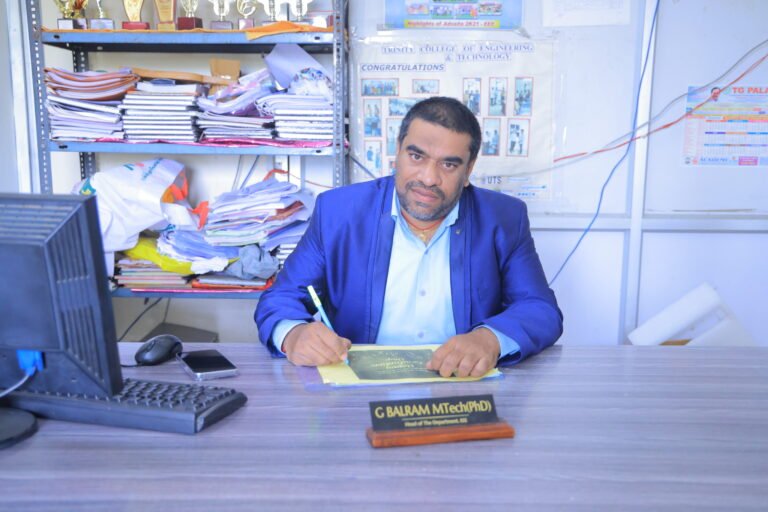
G. BALARAM
Associate Professor & HOD of EEE Dept.
Phone : +91 xxxxxxxxxx
Email : eee.tctk@gmail.com
Head Of The Department
G. BALARAM obtained his B.E (Electrical and Electronics Engineering) from Sri Ramakrishna Institute of Technology, Coimbatore and M.E (Electrical Machines) from P.S.G college of Technology, Coimbatore. He finished his MBA in the field of Educational Management. He also completed his Ph.D degree from Anna University, Chennai in the year of 2017.He has over 14 years of teaching experience at UG and PG level and guided a number of projects in Electrical Engineering and published / presented many articles in Journals and conferences.